A Practical Guide to Durable Waterproof QR Code Stickers
Ever seen a faded, peeling QR code on an outdoor sign? Or a smudged, unreadable one on a restaurant menu? That’s not just a messy sticker; it’s a lost customer and a broken link in your business. When you're using QR codes in any kind of demanding environment, upgrading to waterproof QR code stickers isn't just a nice-to-have—it's essential.
When Good QR Codes Go Bad: Why Durability is Everything
A failed scan is so much more than a minor tech hiccup. It’s a hard stop in the customer journey you’ve worked so hard to create. Think about it: a customer wants your menu, a special offer, or instructions for a piece of equipment. They pull out their phone, aim, and... nothing. That interaction is dead on arrival, and the ripple effects can be surprisingly large.
Take a restaurant with a patio. A standard paper QR sticker on an outdoor table might survive a day or two, but it stands no chance against rain, condensation from a cold drink, or constant wipedowns. Suddenly, your staff is running around with physical menus, service slows down, and customers get frustrated. This isn't a one-off problem; it happens at every table, every single day.
The Hidden Costs of a Failed Sticker
The problem gets even bigger when you look beyond customer-facing uses. Imagine a logistics company using QR codes to track expensive assets across a massive shipping yard. Those assets live outside, facing scorching sun, heavy rain, and even the occasional pressure washing.
A cheap paper or low-grade vinyl sticker will fade fast under UV rays, killing the contrast a phone camera needs to read the code. Worse, it might peel off completely after a good cleaning, creating a "ghost asset" that's vanished from your inventory system. What happens next is a cascade of operational headaches:
- Wasted Time: Your team spends hours trying to find untracked equipment by hand.
- Higher Costs: You end up replacing assets you can't find, assuming they're lost for good.
- Bad Data: Your entire inventory and supply chain data becomes unreliable.
Suddenly, spending a few extra cents on a durable sticker doesn't seem like a cost. It’s a smart investment to prevent much bigger losses down the road.
A failed QR code is a broken promise. It tells your customer that you missed a critical detail, and it quietly undermines their trust in your brand. Investing in durability is really an investment in reliability.
More Than Just a Minor Annoyance
The very places where QR codes are most useful are often the toughest on them. A brewery might slap QR stickers on kegs that are constantly being moved, chilled, and handled roughly. A factory might use them on machinery exposed to oils, chemicals, and high-pressure cleaning. In every one of these scenarios, a standard sticker is set up to fail, turning a brilliant tool into a constant maintenance chore.
This is why you have to think beyond "standard vs. waterproof." A true waterproof QR code sticker is built for this abuse. It’s a combination of the right material, a specific adhesive, and a protective laminate that ensures it stays stuck and scannable for months or years, not just days. Picking the right sticker isn’t about looks—it’s about making sure that critical link between your physical world and your digital one stays open for business, no matter what you throw at it.
Selecting Materials for Maximum Sticker Lifespan
Choosing the right material for your QR code sticker is probably the single most important decision you'll make. It’s the difference between a sticker that peels and fades in a month and one that stays scannable for years.
Think of it like building a house—the foundation determines everything. A beautiful design on a flimsy base is just destined to fail.
To get this right, we need to look at three core components that have to work together: the sticker material itself (the substrate), the protective layer on top (the laminate), and the glue holding it all together (the adhesive). Nail this combination, and you've got a sticker built to last.
The first question is always about the environment. Is this sticker going to have a tough life?

This flowchart really simplifies that first step. If there's any chance of moisture, friction, or direct sun, you absolutely need to go with a durable, waterproof material. It's non-negotiable.
The Foundation: Your Substrate Choices
The substrate is the base layer, the actual "sticker" part of your sticker. Paper labels are fine for dry, indoor uses, but they disintegrate at the first sign of moisture. For any kind of durability, you have to go with a synthetic material.
Vinyl (PVC): This is the flexible workhorse of the sticker world. It’s great at conforming to curves, making it perfect for things like hard hats, water bottles, or equipment with rounded edges. It's naturally waterproof and tough.
Polyester (PET): When you need extreme resilience, polyester is the answer. It has superior resistance to heat, chemicals, and abrasion. This makes it the go-to for industrial settings—think QR codes on machinery that gets cleaned with solvents or on assets stored in a hot warehouse.
Polypropylene (BOPP): This is your best bet for products that live in the fridge or freezer. Polypropylene is an excellent moisture barrier and holds up well against oils and many chemicals, making it a favorite for food packaging and cosmetic products.
You wouldn't use a rigid polyester sticker on a curved helmet, and you wouldn't rely on standard vinyl for a piece of machinery that gets doused in harsh cleaning agents. The material has to fit the job.
The Shield: Protective Laminates
A laminate is a thin, clear film applied over the printed sticker. It’s the shield that protects the ink and the QR code from everything the world throws at it. This step is what turns a regular sticker into a long-lasting business tool.
Your two most common choices are gloss and matte, and this decision is about more than just looks.
A gloss laminate gives you a shiny, vibrant finish that makes colors pop. More importantly, it offers excellent UV resistance, which is critical for stopping the sun from fading your QR code into an unreadable gray square. This is my top recommendation for any outdoor application.
On the other hand, a matte laminate provides a non-reflective, satin finish. Its key benefit is cutting down on glare. In brightly lit indoor spaces like a trade show floor or under direct retail lighting, a matte finish can make the QR code much easier for a phone to scan without annoying reflections.
My Pro Tip: When in doubt, test it out. Before ordering thousands of stickers, get a small sample batch with both gloss and matte finishes. Stick them where they'll actually be used and try scanning them at different times of day to see how the light affects scannability.
The Bond: Choosing the Right Adhesive
The final piece of the puzzle is the adhesive—the glue. The wrong one means peeling corners and, eventually, a sticker on the floor.
For most durable applications, a permanent adhesive is the standard. It creates a strong bond that actually gets stronger over the first 24-72 hours. This is what you want for asset tags, warning labels, and any sticker you expect to stay put for years.
In contrast, a removable adhesive is for temporary use, like a promo sticker on a new laptop or a QR code for a weekend event. It holds firm but peels off cleanly without leaving that frustrating, sticky residue behind.
Finally, for really tricky surfaces—like textured plastics or powder-coated metal—you may need a high-tack adhesive. This is an aggressive, industrial-strength glue made to grab onto those low-energy surfaces where standard adhesives just won't stick.
The right combination of substrate, laminate, and adhesive produces real-world results. We've seen from industry data that synthetic materials with an overlaminate can extend a sticker's functional life from a few months to 36+ months, even outdoors or in refrigerated supply chains.
For asset tracking, this means using labels that can withstand 3-5 years of exposure and thousands of wash cycles, which often requires a permanent acrylic adhesive with high peel strength. You can find more details on this in research on the labels market and material performance.
Here’s a quick-glance table to help you put these pieces together for your specific situation.
Material and Finish Comparison for Waterproof QR Stickers
| Component | Option | Best Use Case | Key Benefit |
|---|---|---|---|
| Substrate | Vinyl (PVC) | Curved or flexible surfaces (helmets, bottles) | Conforms to shape, good durability |
| Polyester (PET) | Flat, harsh environments (machinery, outdoor assets) | Extreme resistance to heat & chemicals | |
| Polypropylene (BOPP) | Refrigerated/frozen products, cosmetics | Excellent moisture and oil barrier | |
| Laminate | Gloss | Outdoor use, applications needing UV protection | Protects from sun fading, enhances color |
| Matte | Brightly lit indoor areas (retail, trade shows) | Reduces glare for easier scanning | |
| Adhesive | Permanent | Long-term asset tagging, warning labels | Creates a strong, lasting bond |
| Removable | Temporary promotions, event signage | Peels off cleanly without residue | |
| High-Tack | Textured or low-energy surfaces (powder coats) | Aggressive bond for difficult materials |
By thoughtfully selecting each component, you're not just buying a sticker; you're engineering a reliable communication tool that’s actually built to survive its environment.
Designing QR Codes That Actually Scan
You can have the toughest, most perfectly engineered waterproof sticker in the world, but if the QR code on it doesn't scan, it's just a useless square. The design of the code itself is every bit as critical as the vinyl it’s printed on. A fussy, unreadable code just creates a dead end for your users, completely defeating the purpose.
To make sure your waterproof QR code stickers work every time, you need to nail a few key design basics. These aren't just about aesthetics; they're technical requirements that directly impact whether a phone can read your code. Get these right, and your stickers will perform flawlessly out in the real world.
Size and Distance: A Practical Guide
When it comes to QR codes, bigger is almost always better. One of the most common reasons a scan fails is simply because the code is too small to be read easily. While modern phones are impressive, you can't expect them to resolve a tiny code from a distance.
As a hard and fast rule, never, ever print a QR code smaller than 0.8 x 0.8 inches (2 x 2 cm). Think of this as the absolute bare minimum for reliable, close-up scanning. For anything that won't be scanned from six inches away—like a sticker on a piece of machinery or a sign on a wall—you need to scale up.
A great rule of thumb I always use is the 10:1 distance-to-size ratio. The idea is that the width of the QR code should be about one-tenth of the expected scanning distance.
- Scanning from 1 foot away? Your code needs to be at least 1.2 inches wide.
- Scanning from 5 feet away? Plan for a code that's at least 6 inches wide.
This simple bit of math ensures people can scan your code without having to lean over awkwardly or get dangerously close to equipment just to get a read.
Contrast Is Everything
That stylish, low-contrast design you mocked up on screen might look great, but it’s a recipe for failure on a physical sticker. Scanners work by seeing a clear difference between the dark and light squares (or "modules"). Without high contrast, the app just can't make sense of the data.
The classic black-on-white is the gold standard for a reason: it delivers maximum contrast and the best scannability. You can get creative with other colors, but the principle is the same: pair a very dark color with a very light background. A navy blue code on a pale yellow background will probably work fine. A medium-gray code on a light blue background? You're asking for trouble, especially in poor lighting.
Whatever you do, don't invert the colors. A light QR code on a dark background is a guaranteed way to make it unreadable for most phone cameras and scanning apps. Always stick to dark-on-light.
Don't Crowd the "Quiet Zone"
Every QR code needs a bit of personal space. This empty margin around the outside is called the quiet zone, and it’s critical for telling a scanner where the code begins and ends. If you cram text, logos, or other graphics right up against the edge, the scanner gets confused and often fails.
Make sure you leave a clear margin on all four sides of the code. The standard is a width of at least four of the little black squares (modules). Most good QR code generators add this buffer automatically, but if you're placing it in a larger design, be sure to give it plenty of room to breathe. It’s a tiny detail that makes a massive difference.
Printing Methods for Lasting Scannability
The printing process itself is just as crucial as the sticker material for long-term use. For QR codes that need to survive years of abuse, two methods are clear winners.
Thermal Transfer Printing: This process uses a heated printhead to melt a durable resin ribbon directly onto the sticker. The resulting image is incredibly tough, capable of resisting scratches, chemicals, and extreme heat. It’s my go-to recommendation for industrial asset tags or any label destined for a harsh environment.
UV-Cured Inks: Here, liquid ink is applied to the sticker and then instantly hardened with ultraviolet light. This creates a durable, solid layer of ink that’s highly resistant to fading from sunlight. If your waterproof QR code stickers are going outdoors, printing with UV-cured inks is non-negotiable to keep them scannable for years to come.
One final pro tip: always generate your QR code in a vector format like SVG or EPS. Unlike pixel-based files (like JPG or PNG), vectors can be scaled to any size without getting blurry or losing sharpness. This ensures your code is crisp and clean, whether it's on a tiny product label or a massive sign. And before you order a thousand stickers, always print a one-off sample and test it in the actual environment where it will live.
Getting Your Stickers to Stick for Good
You can spend all the time in the world designing the perfect waterproof QR code sticker, but if it's not applied correctly, it's all for nothing. I’ve seen it happen countless times: a fantastic, durable sticker starts peeling in weeks simply because of a rushed application. Getting it right isn't just about peel-and-stick; it’s about creating a permanent bond that can take a beating.
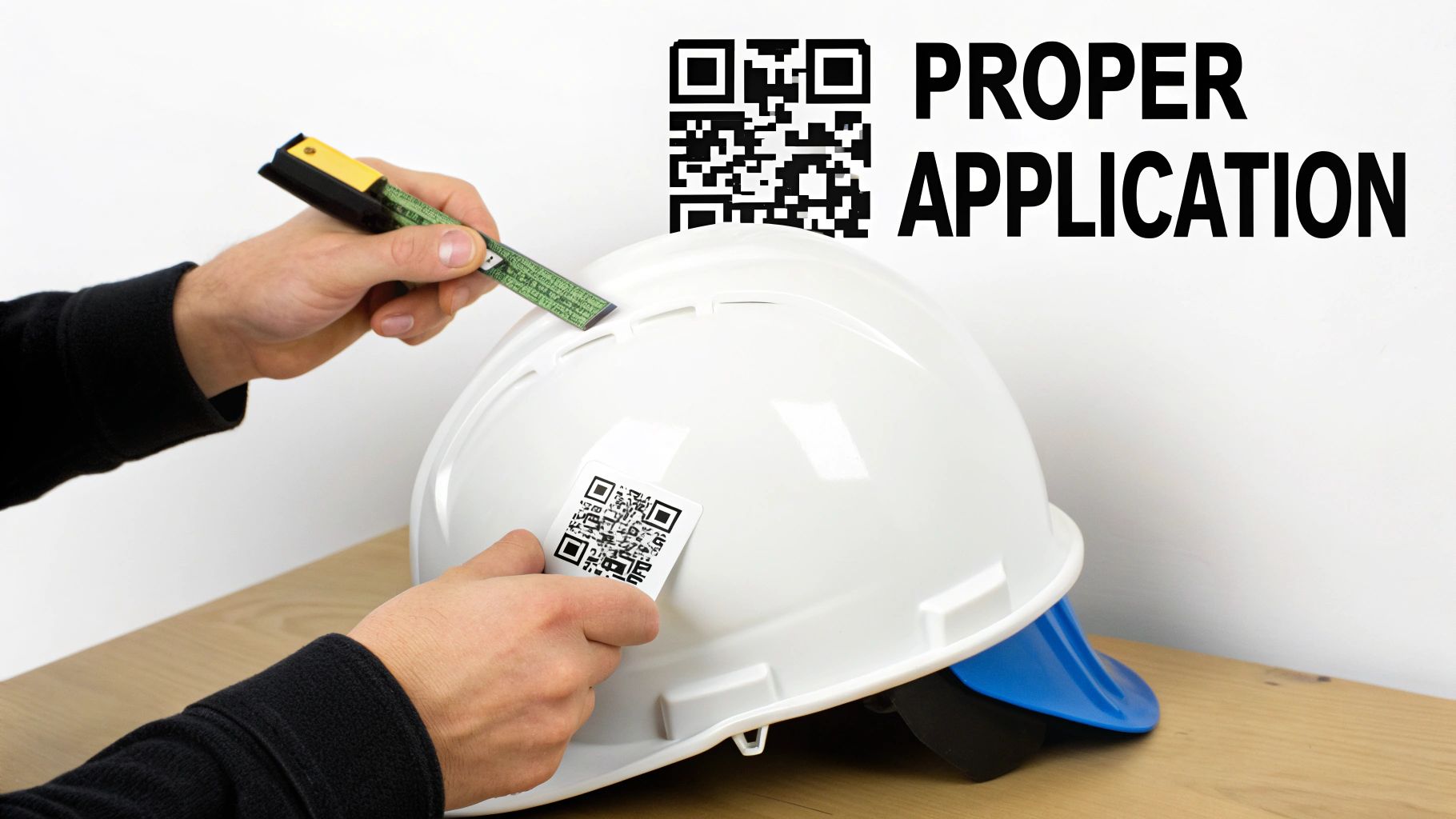
Think of it like painting. You’d never just throw a coat of paint on a dirty, dusty wall and expect a professional finish. The prep work is what makes the final result last. The exact same rules apply here.
Start With a Spotless Surface
The number one killer of sticker adhesion is a dirty surface. It's that simple. Dust, grime, grease, and even the oils from your fingers create a microscopic barrier that stops the adhesive from grabbing on properly. Your first move, always, is to prep the area.
Your best friend for this job is isopropyl alcohol (rubbing alcohol) and a clean, lint-free cloth. A quick wipe-down with alcohol is perfect because it cuts through any unseen oils and then evaporates completely, leaving zero residue. If you're dealing with really grimy equipment, give it a wash with mild soap and water first, let it dry thoroughly, and then do the final alcohol wipe.
Pay Attention to Temperature and Time
Sticker adhesives are surprisingly sensitive to temperature. Trying to apply one in the freezing cold or on a scorching hot day can ruin its ability to bond. Most permanent adhesives work best within a moderate temperature window, usually between 50°F and 90°F (10°C and 32°C).
If it's too cold, the adhesive becomes stiff and brittle, so it can’t flow into the tiny pores of the surface to get a good grip. Too hot, and it can turn into a gummy mess. The easy solution? Apply your stickers indoors or at least in the shade, and give the surface a chance to reach a normal temperature.
Pro Tip: Once the sticker is on, the adhesive needs time to "cure" and reach its maximum strength. This curing process can take anywhere from 24 to 72 hours. Try to avoid subjecting the sticker to anything extreme—like a pressure washer or wild temperature swings—during this initial period.
How to Handle Tricky Surfaces
Of course, not every surface is a perfect, flat square. Applying stickers to curves, textures, or large areas without getting bubbles and wrinkles is what separates a professional job from an amateur one.
Here’s my advice for a few common scenarios:
Flat, Smooth Surfaces (Metal panels, glass windows): Don't just slap the whole thing down. Start by anchoring one edge of the sticker. Then, use a plastic squeegee or even the edge of a credit card to slowly press the sticker down, working from the center outwards. This technique forces any trapped air out to the edges, leaving you with a flawless, bubble-free finish.
Curved Surfaces (Hard hats, water bottles): For a gentle curve, the same center-out method works well. If you’re dealing with a more complex shape, a little heat is your secret weapon. A quick blast from a hairdryer will make the vinyl just pliable enough to stretch and conform to the curve without creasing.
Textured Surfaces (Powder-coated equipment, pebbled plastic): On these surfaces, getting the adhesive into all the little nooks and crannies is key. First, apply the sticker with firm pressure. Then, gently heat it with a hairdryer and use a soft cloth to press it down again, forcing the vinyl to mold to the texture. This dramatically increases the surface area the adhesive is bonded to, making for a much stronger hold.
Taking just a few extra minutes to prep the surface and use the right technique will make all the difference, ensuring your QR codes stay exactly where you put them.
Keeping Your QR Codes Working in the Wild
So, your waterproof QR code stickers are on your equipment and out in the world. Job done? Not quite. Now comes the real test: making sure they keep working, day in and day out. A little proactive testing and maintenance goes a long way in keeping those physical-to-digital links reliable for the long haul.
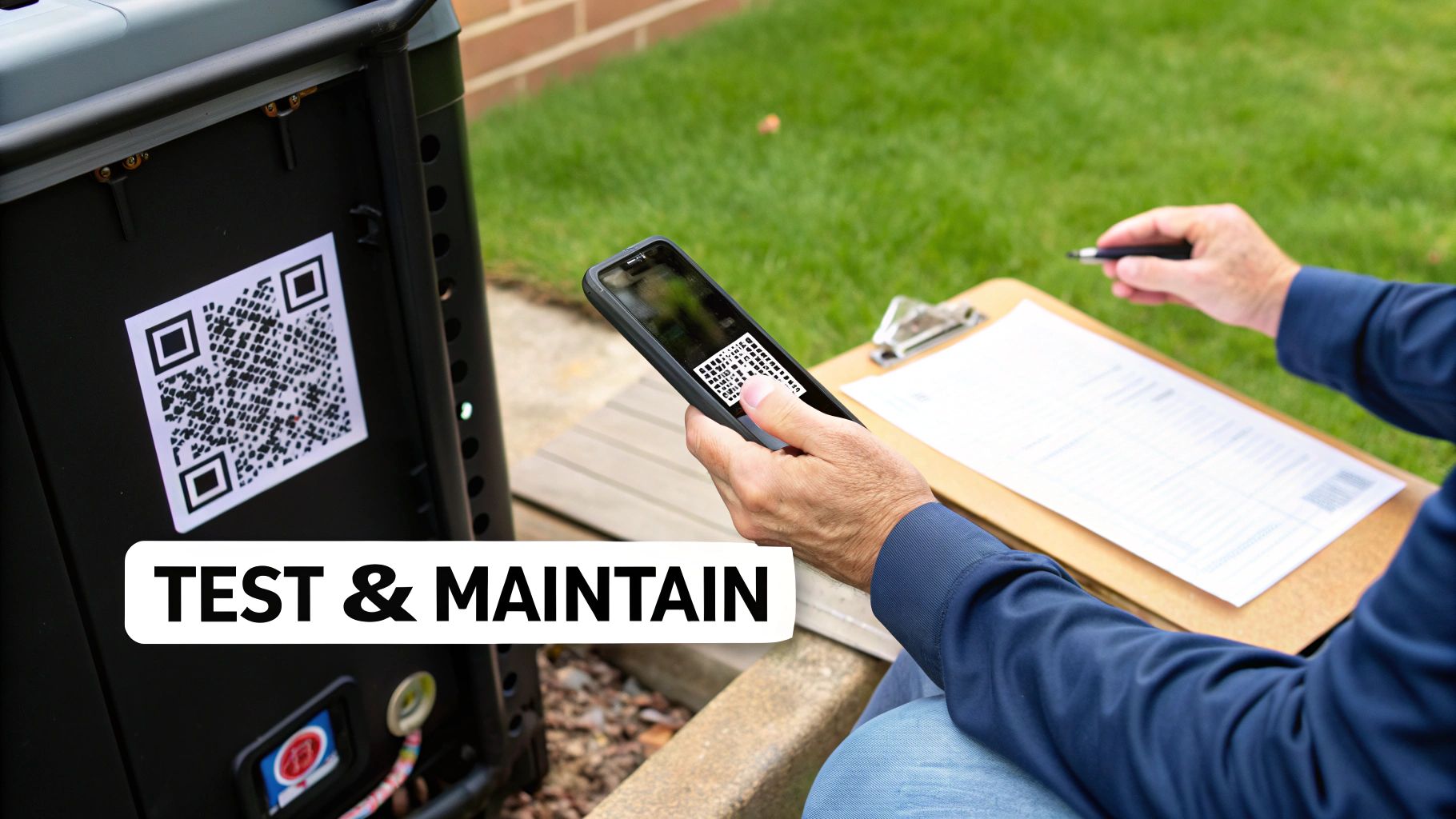
Think about it this way: you’d never launch a new website without testing it on different browsers and devices. Your QR code is a physical gateway, and it needs the same kind of real-world checkup to make sure it works for everyone, every time.
A Simple, Real-World Testing Protocol
You don't need a complicated plan here. The idea is just to spot-check your stickers in the environments where they actually live. This is how you find potential scanning problems before your customers or staff do.
First, grab a few different smartphones. Make sure to include both new models and some that are a few years old to account for varying camera quality. Then, just walk around and start scanning in different conditions.
Vary the Lighting: Try scanning a code in bright, direct sunlight. Then, test another one in the shadows of a warehouse or after dusk. Glare from a gloss finish or just low light can sometimes trip up a phone's camera.
Test Different Angles: Nobody scans a QR code from a perfect, head-on position. Try scanning from the side, from a bit further away, or while walking past, just like a real person would.
Check a Mix of Devices: Does the code scan instantly on an iPhone but struggle on an older Android? If so, you might have a contrast or design issue that needs a second look.
Running through this quick audit will give you real confidence that your QR codes can handle the abuse of daily use.
Setting Up a Practical Maintenance Schedule
For stickers on equipment that gets a lot of use or lives in a tough environment, a simple maintenance routine is your best friend. Dirt and damage can build up slowly, eventually making a code unscannable. A quick visual inspection is all it takes to stay ahead of the problem.
A sticker can look perfectly fine from a few feet away, but a closer look might reveal a deep scratch or a peeling corner right over a critical part of the code. That ten-second glance is your first line of defense against a broken link.
It's easy to build this into existing routines. A restaurant manager can make wiping down and checking the QR codes on patio tables part of their daily opening duties. In a warehouse, a supervisor could schedule a quick monthly walk-through to check the asset tags on forklifts and pallet jacks.
During these checks, you're looking for the obvious culprits:
- Edges that are peeling or lifting up
- Deep scratches or gouges across the printed area
- A buildup of grease, dirt, or other grime
- Any noticeable fading or discoloration from UV exposure
How to Clean Your Stickers the Right Way
When a sticker gets dirty, how you clean it matters. The wrong chemical or a rough sponge can permanently damage the protective laminate and the ink underneath in seconds.
The best approach is always a soft, lint-free cloth (microfiber works perfectly) and a simple mix of mild soap and water. Just wipe the surface gently and pat it dry. Stay far away from abrasive scrubbers, steel wool, or harsh chemicals like acetone or industrial degreasers—they will eat right through the vinyl.
This kind of hands-on approach ensures your waterproof QR code stickers keep delivering value and a smooth experience long after they’re installed.
So, Are Durable QR Codes Really Worth the Investment?
After digging into all the specifics—materials, laminates, design, and even how to stick them on properly—you might be wondering if it's all worth the effort. The short answer? Absolutely.
Think of it this way: a high-quality, waterproof QR code sticker isn't just an upgrade; it's a core component of how businesses operate today. We're well past the point where these are a novelty.
Whether you're tracking expensive equipment in a rainy storage yard or letting customers pull up a menu at an outdoor patio table, these codes are your link between the physical world and your digital systems. A cheap sticker that peels, fades, or just won't scan is more than an inconvenience. It's a broken link in your operations, a frustrating dead end for your customer, and a potential point of data loss.
The Market Doesn't Lie
This isn't just a hunch; the numbers back it up. We're seeing a huge shift toward industrial-strength labeling solutions across the board.
The market for QR code labels is on a serious upward trajectory, expected to hit USD 1.8 billion in 2025 and projected to more than double to USD 4.1 billion by 2035. What's driving this? A big part of it is the rise of connected packaging and interactive consumer products—exactly the places where a sticker has to survive sun, rain, and condensation. If you want to dive deeper into the trends, this QR code labels market analysis is a great read.
What this tells us is that opting for robust, weatherproof stickers isn't just about preventing a few headaches. It's about getting in sync with where the entire industry is moving. As more businesses rely on these codes for critical functions, the demand for versions that can handle real-world abuse is only going to grow.
Choosing a durable QR code sticker is a strategic decision. You're not just buying a label; you're investing in the reliability of the bridge connecting your physical assets to your digital infrastructure.
When you get right down to it, everything we've covered—from picking the right polyester and a tough UV laminate to just making sure the surface is clean before application—all points to a single goal: making sure the code works, every single time. By treating your QR code stickers as the essential tools they are, you're building a more reliable, efficient, and user-friendly operation from the ground up.
Your Questions About Waterproof QR Codes, Answered
We get a lot of questions about getting waterproof QR code stickers just right. Let's walk through some of the most common ones we hear from business owners so you can avoid the usual pitfalls.
Can You Print a QR Code on a Clear Sticker?
Absolutely, but there's a trick to it. If you just print a standard black QR code on a clear sticker, it will only work if you place it on a light, solid-colored surface. A camera needs strong contrast to read the code, and sticking it on a dark, patterned, or glass surface will make it virtually invisible to a scanner.
For a sticker that works anywhere, the best practice is to print the QR code with a layer of white ink behind it. This creates a built-in, high-contrast background right on the sticker, guaranteeing it will scan perfectly no matter where you put it.
What's the Smallest a Waterproof QR Code Can Be?
It's tempting to make QR codes as small and discreet as possible, but don't go too small. The absolute minimum for reliable scanning is 0.8 x 0.8 inches (or 2 x 2 cm). Anything smaller is asking for trouble, as even a little bit of dirt or poor lighting can cause it to fail.
A good rule of thumb is the 10:1 distance-to-size ratio. Think about how far away someone will be when they scan it. If you expect them to scan it from 2 feet away, your QR code needs to be at least 2.4 inches wide to be user-friendly.
Our Takeaway: When in doubt, go bigger. A slightly larger sticker that scans instantly is a far better user experience than a tiny one that just leads to frustration.
How Do You Make a QR Code Sticker Actually Last Outdoors?
Making a QR code that can stand up to Mother Nature isn't about just one thing—it’s about the combination of materials you choose. You need a three-part system to get it right.
- The Right Material: Start with a tough, waterproof base. We almost always recommend polyester (PET) or a high-performance vinyl because they won't degrade from moisture or temperature swings.
- The Right Ink: The printing process matters. Using UV-cured inks is essential. This type of ink is hardened by UV light, making it incredibly resistant to fading from sun exposure—which is the main reason outdoor QR codes stop working.
- A Protective Finish: The final piece is a UV-resistant gloss laminate. This clear top layer is like a shield, protecting the printed code from sun, rain, and physical scuffs, keeping it sharp and scannable for years.
When these three elements work together, you get a QR code sticker that's built to last.
Ready to create QR Code Stickers that stand out and stand up to the elements? Visit us at https://blog.qrcodestickers.net for more practical guides and creative ideas to turn your stickers into powerful business tools.